Interview: Eduardo Florez, Founder of The Colombian Coffee Co.
The Colombian Coffee Co. recently opened a new site in East London, so we sat sown with founder Eduardo Florez to talk about his story and philosophy, and get his insights on London's coffee culture
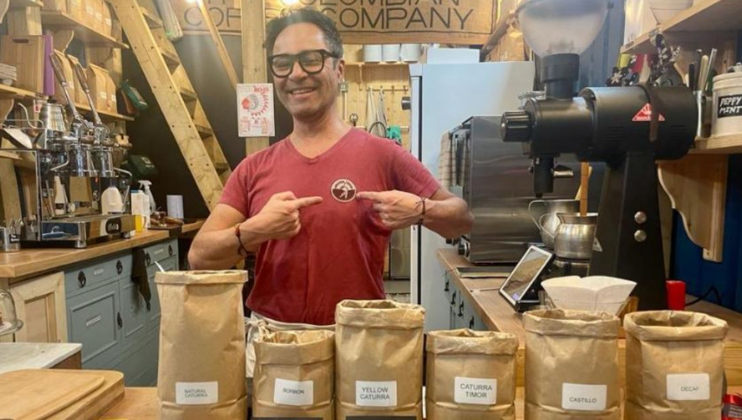
Hi Eduardo! What's the story behind The Colombian Coffee Co.?
I was born in a country at war (Colombia) and [whilst] living here in England I thought ‘well, I could do something for my country’. That's kind of the origin.
The reason why I'm in England is…it's a love story (4:03) I met an English woman in Colombia a long time ago, and then when I came here I started in business - I did a master's in finance and then I did an MBA - [but] I got a little bit disillusioned by the
lack of soul in the corporate world, just chasing profits almost without reason.
About 16 years ago I read an article about the peace in Colombia. It was the first time that I read these two words: ‘Colombia, post-conflict’ - that made a big change in my life, it felt like a cut and since that day I was really impressed by the thought that peace happened one day in Colombia and it was something that never happened before - obviously there have been so many efforts to bring peace, but it was the first time that I actually believed in it.
So probably it was a good timing and then with that that's when I [thought]: ‘What am I doing? Am I working here for companies just because everyone is chasing profits? Or should I do something for my country?’
That's when I twist [sic] and then I worked for one year for the RYCO, the Rwandan Youth Information Community Organisation, and working with them I learned the challenges of running a charity. While working there, I met, well I read of another charity called Bottletop - it was an interesting charity because they make bags and bells out of bottletops.
That's how I made an interesting connection; how to connect the luxury market in London with a grassroot project.
I sat down at a table and started writing: I'm going to set up a social enterprise. It's going to be called the Colombian Coffee Company, and we are going to help victims of the conflict and indigenous communities. And since then it's been a rollercoaster really.
Why coffee, specifically?
Coffee is such a big part of our culture in Colombia that I thought it had to be coffee. Personally, as a teenager I remember the day my father had to cut all the coffee trees because it was such a big bad business [that] he decided to go for oranges and mandarins instead. So I have always felt something curious and strange about that lost coffee and it's like a beautiful connection back to the past.
So many farmers in Colombia have difficulties, it's not easy in the supply chain of the entire coffee, [but] the most difficult part is actually growing coffee. There are many coffee growing communities in parts that are constantly being affected by the conflict, so it's very difficult to grow coffee in those circumstances.
For instance, the south of Colombia - Cauca, Nariño - used to be called Corredor de la Guerrilla - ‘the guerrilla corridor’ - because [guerilla fighters] could escape to Ecuador. High up mountains - between 1,500 and 2,000 metres above the sea level - is where you get the chances of getting a better quality coffee. At the same height, you can also grow opium and coca, so you have many criminal gangs - be it paramilitaries or guerrilla groups - forcing farmers to grow illegal crops.
I strongly believe that actually coffee could make a huge difference, but it will only do so if farmers receive a fair price. I'm not talking about Fair Trade - that's a beautiful initiative, but it is just some coins on top of a kilogramme of coffee, and I don't like also the dignity lost in a way of people buying a product out of pity.
I think I like more the idea of English people buying coffee because it's a good quality coffee. That brings back the dignity to farmers and it is only fair. Colombia produces some of the best quality coffees in the world. It would make change, it would make justice if farmers could benefit.
So what is your approach?
The challenge is big in Colombia. You can imagine, for instance, farmers that have been running their farm constantly on a debt.
There's also during the harvest - they have to bring people to help collect and pick up the cherries, [and] most farmers end up paying 70% of the cost of running the farm to pay that. So it's very labour intensive, and on top of that many families don't have access to markets. Some families live three days away from the nearest town that has roads. So they have to bring down their coffee. They pay for the transport - who else [will]? So their coffee becomes even more expensive, although they sell it at the same price because it's market prices. So [there is] less incentive to produce quality, but I think quality pays back more.
We can pay more; if a farmer receives more money, he can pay more to the cherry pickers, and the cherry pickers will collect more carefully just the right coffees. So it is a circle, and it is a strange circle.
I think that help is supporting [the farmers] to grow organic, to continue growing organic, but also to receive a better pay. So sometimes we pay way above market prices, like sometimes you get twice what the market prices pay. So it is a good opportunity for a farmer, but obviously we do, first of all, think in [terms of] quality.
So that's what we do differently. We encourage quality, we pay for quality, we pay above market prices, and that obviously makes a straight economic impact on a family, and that generates social impact. That's what we're trying to achieve.
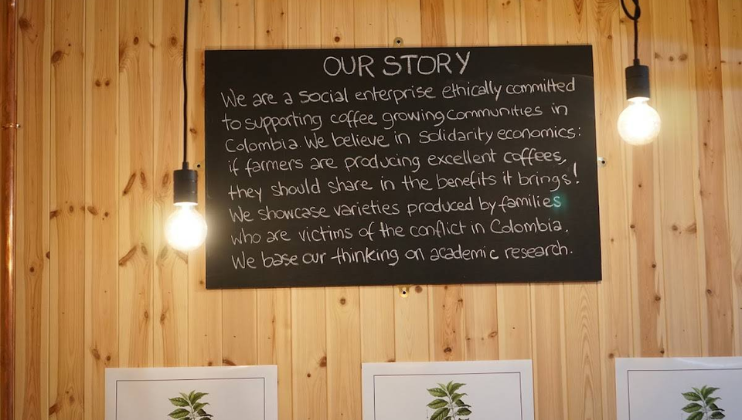
How did the company expand?
Setting up here was a very interesting one, because when I first visited Borough Market I was impressed, and also surprised, because I thought that all the food in England was in the supermarkets; so going to Borough Market was like being in Colombia. I totally fell in love with the market, and I thought: ‘this has to be’.
I spent four years knocking at the door, because it's very difficult to get accepted; you have to have a very unique product - a product that is ethically sourced, that has a clear provenance and traceability. Also, it's just very street food quality. And on top of that, I imagine the amount of coffee houses that apply to Borough Market is intense. So, during those four years, I [took] every opportunity to talk about coffee, and about the conflict in Colombia, and to showcase the coffee that I could bring. I went to festivals, offices, universities, schools, street markets, whatever I could in order to talk about Colombia and the challenges for Colombians. It was interesting as well because, when I first arrived, I was so impressed that [only] a few coffee houses have Colombian coffee. People were very proud to showcase Colombian coffees, but they didn't know much about the varieties or what parts of the country. It was just a general word; ‘Colombian coffees’. So with that, it's been a great opportunity for me to talk more about coffee culture from Colombia.
We opened in Borough Market, [and] at the beginning I was roasting coffee in my house in the garage. And as you probably have seen photos of the store in Borough Market, at the beginning, it was all the furniture that I have in my house. Slowly and slowly, the people accepted our product. People really like our coffees. So it was an amazing opportunity to bring more and more.
And then all of a sudden, I realised that the garage was not enough space. I had sacks of green coffee in the lounge, and it was really difficult, so I managed to get a loan from an organisation that helps social enterprise startups, and I managed to get a place nearby, under the arches near London Bridge in Flatiron Square. I managed to bring the machine to set up a roastery there, and [from there] it was a steady growth. I really thank Borough Market and Londoners that really appreciate the coffees and also the story behind our coffees.
We opened in Soho three or four years ago. It has been fantastic because, traditionally in Soho, the only coffee that you find is the Italian style coffees that are (in my humble opinion) very bitter. People really enjoyed [it], and it's fantastic now to hear people telling us that the best coffee in Soho is ours - I'm very proud of that.
Then, with that growth, we just couldn't cope with roasting in a little lodge under the train line. We have been looking for for a couple of years now; I really love the city of London, and this area of Shoreditch and Whitechapel - I was always looking for little shops, little opportunities, basements…anything…and then one day we found this place and so we slowly moved in here. Eventually, we'll be able to get a bigger roasting machine!
So we have four places at the moment [Borough Market, Flatiron Square, Soho and Shoreditch].
Is there a distinctive London coffee culture, and if so, what defines it?
Yes, absolutely. I love the coffee culture here.
I imagine it had to do with the Australians that came here a while ago - probably 15-20 years ago - and brought the high coffee culture. Although there were already companies here working on quite high quality, like Monmouth Coffee Company for instance.
The Australians brought the barista world and, since then, the specialty coffee market hasn't stopped. Coffees get graded from 0 to 100, and all the coffees that receive more than 80 points - this is what is called ‘specialty coffee’.
Now, specialty coffee is growing at a faster rate than standard coffee. So for instance, you see many Starbucks, Cafe Costas and Cafe Neros. However, now you see more and more specialty coffee houses - not on the high street, but just in the streets behind.
So it is an amazing market because it's proving that it is helping farmers. We pay above what the standard coffee market pays to farmers. So that in itself is a unique thing that London is doing.
And on top of that, London is a pot for many trends. And I think the coffee trend that has come out of the market is going to many cities. Even in Bogota now, you have coffee houses that have been set up inspired by the London coffee culture - the London coffee culture has created something unique in the world, this love for specialty coffee, and for quality.
What, in your opinion, makes a good coffee?
Wow, that is a fantastic question…it's a difficult question because a good coffee needs three things; it’s three different aspects. One is the process in the country of origin, another one is the roasting and another one is the barista brewing it, or or the way you brew it at home. You can dramatically damage a good coffee if you roast it badly - if you burn it at roasting - so we have to roast very carefully.
But, to me, the most important thing is the quality of the coffee - so the bean - for that, Colombia has a great position on Earth because we are so close to the equatorial line [sic] and the amount of mountains; it has a lot of volcanoes, so the soil in those mountains [is] very rich with minerals. Being close to the equatorial line also gives just the perfect weather, so the conditions in Colombia are quite peculiar to produce excellent coffees.
If it comes from a good area, and it has been produced carefully, you can definitely have a good coffee.
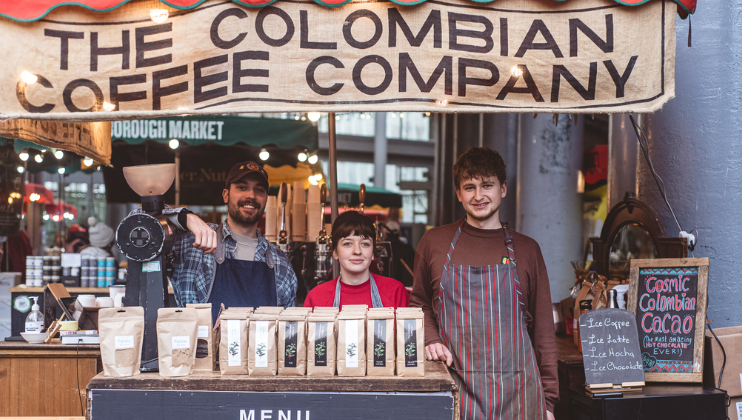
The Colombian Coffee Co. has sites in:
Borough Market, Southwark
Flatiron Square, Southwark
Greek St, Soho
Goulston St, Whitechapel